
3 Aug 2022 Magic Himalaya Treks
Animals in Everest region
Nepal is a small nation in Asia with many varieties of things to offer. Nepal is very popular for Himalayan ranges and water resources. Nepal, a Himalayan country Nepal is not only the place of high Himalayan ranges but also rich in diverse wildlife. Our country, Nepal, is blessed with nature. Our country has a diverse wildlife environment throughout. Nepal is also the hotspot for biodiversity and natural inhabitants. It is gift to have all these despite a small areas land between the two giant nations India and china. We have Chitwan National Park, Sagarmatha National Park, Bardia National Park, and many conservation areas with different kinds of flora and fauna.
The Everest regions come under the Sagarmatha National Park, which is one of the protected areas in northeast Nepal. This Everest region is dominated by high snow-capped mountains, including Mt. Everest (8848.86 m), Mt. Amadablam, Mt. Thamserku, Mt. Pumori, Mt. Lhotse, Mt. Nuptse, and many more. It is not common to have normal human life in this climate and temperature, but mountains are the inhabitants for a few rare mammals, birds, and reptiles. Due to the inhabitants of different fauna, the Nepal government has listed this region as a national park. The park has also been listed as a UNESCO World Heritage site and is now considered one of the renowned national parks of Nepal. Along with Everest, this national park also saves the rare and endangered flora and fauna.
Higher Belt of Everest
The animals, such as the musk deer, clouded leopard, red panda, wild yak, snow leopard, and Himalayan tahr, are major attractions of the park. Among them Red panda and Snow Leopard are listed as endangered Species in the world. The thick fur and thick skin save them from extreme cold. People doing Everest base camp trek might encounter with those animal but need to be lucky enough to experience such a mythical moment. We have to go higher to see blue sheep, pikas, wild yaks, and Tibetan gazelles because they only survive in higher elevations
Lower belt of Everest
There is dense forest where you will get a wide range of wildlife. The animals, such as mountain wolves, Himalayan black bears, leopard cats, wild boars, wild dogs, and barking deer, can be seen in the lower part of the region. The endangered mountain goat, red panda, and Himalayan goral primarily inhabit the dense alpine forest.
Here are some unique animals found in Everest regions:
Himalayan Musk Deer
The terrain of Debuche, Tyangboche, and Portse around the Khumbu area is home to the beautiful creatures of the mountains. The white-bellied deer is listed on the IUCN endangered list. They are shy in nature mostly. Deer hide in the dense green leaves and graze far from human movements. They are seen on open land during winter. They come to open land for sunlight.
Snow Leopard
Snow leopards are native to the mountains of Central Asia, including Mt. Everest. These large cats are endangered and incredibly rare. There are approximately 6,000 remaining. Leopards are specially adapted to their cold and high-altitude environment. They have thick insulating fur and wide feet for sure-footedness even on snowy rock walls. Snow leopards kill the ibex and sheep that make Everest their home. They are listed in the IUCN threatened species and are mostly found in alpine habitats. We see them in Gokyo trekking.
Himalayan Tahr (Mountain Goat)
The Himalayan tahr is another majestic animal found in the Everest region. They are found from 3000 m to 4200 m above sea level. These animals have thick, reddish wool coats as well as backwards-curved horns. The mountain goat is well adapted to the harsh weather of the Himalayas. We can see these animals during the trek from Namche to Kyangjuma below the Everest View Hotel. We can also see them at Pangboche, Phortse, etc.
Red panda
Red panda is another The most beautiful and wonderful endangered creature, which is found in the Himalayan region of Nepal. They eat bamboo and are also listed as IUCN threatened species in the world. Pandas are of shy nature. They are cryptic and elusive animals that are legally protected now. Red pandas are tough to see in normal areas. Jorsella in the Everest region is the most likely inhabitant of this animal.
Martens
Martens are weasel-like animals. They are mostly found in the subtropical forest of the Himalayan part. They are basically carnivorous animal. Martens usually hunt musk deer as well as some birds as their diet. The yellow-throated martens normally occupy the woodlands in Khumbu. It is especially found near the Namche village.
Tibetan Snowcock
The Tibetan snowcock is a non-migratory, noisy partridge. It is another attraction of the Khumbu region. In the late autumn and winter, you can find them in large groups near the trekking trail. They are not shy like other animals. We can observe them grazing near human settlements and even close to people who are sitting around. They are also found in the Gokyo valley and around high altitudes.
The blood pheasant is also referred to as the blood partridge. It is the only species in the genus Ithaginis and tribe Ithaginini of a pleasant family. They are small, short-tailed, colorful birds. I am one of the other attractions of the Everest region. The blood in its name comes from the fact that its face, eye, and tail are crimson in color. They are commonly found in the birch forests of Tengboche, Deboche, Dole, and Phortse.
Himalayan Monal
We all have seen the Danphe in the Everest region because it is the home of this bird. It is the national bird of Nepal. The Impeyan monal and impean pheasant is a native of the Himalayas. They are usually found at an altitude of 2100-4500 m. During the autumn time, we can easily see them in the sunny part of the Himalayan terrain of Namche and Pangboche. They also descend to lower altitudes when winter strikes in the mountain area.
Golden Eagle
Golden eagles are primarily known as the tiger in the bird kingdom. It is a widely distributed species of eagle. The dark brown makes their hunting territory like a tiger. They are regarded with profound mystic reverence in some ancient tribal cultures. They make their wings in a V shape while soaring. We can see them in Namche, Dingboche, Pheriche, Thame, and sometimes Gokyo Valley.
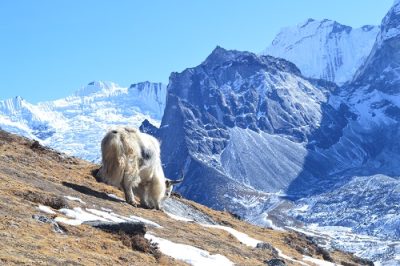
Mountain Yak
Mountain yak is another important name in the Himalayas. Mountain yaks are born to survive and thrive in extremely high-altitude weather conditions. Normally people used them as a means of transportation in mountain regions. The yak hair is also used to make different kinds of warm clothes and duvets. Their horns are used in the decoration. Their milk is used for making butter and cheese. Even in high mountains, their dung is used as a fire to cook food. They have religious importance to the people of the Everest region. We can see them from Namche to Everest Base Camp Trek.
Besides these beautiful mammals and birds, we can see other varieties of creatures. We can see beautiful creatures like the Himalayan black bear, blue sheep, rhesus macaque, pika, Tibetan gazelle, mountain weasel, marmots, and griffon vulture. All these make the Everest region their home. We can cherish all this beauty along with Everest when we do trekking like the Everest base camp trek, the Everest base camp luxury trek, the Everest yoga trek, high passes, and Gokyo. Come join Magic Himalaya to experience all of nature.